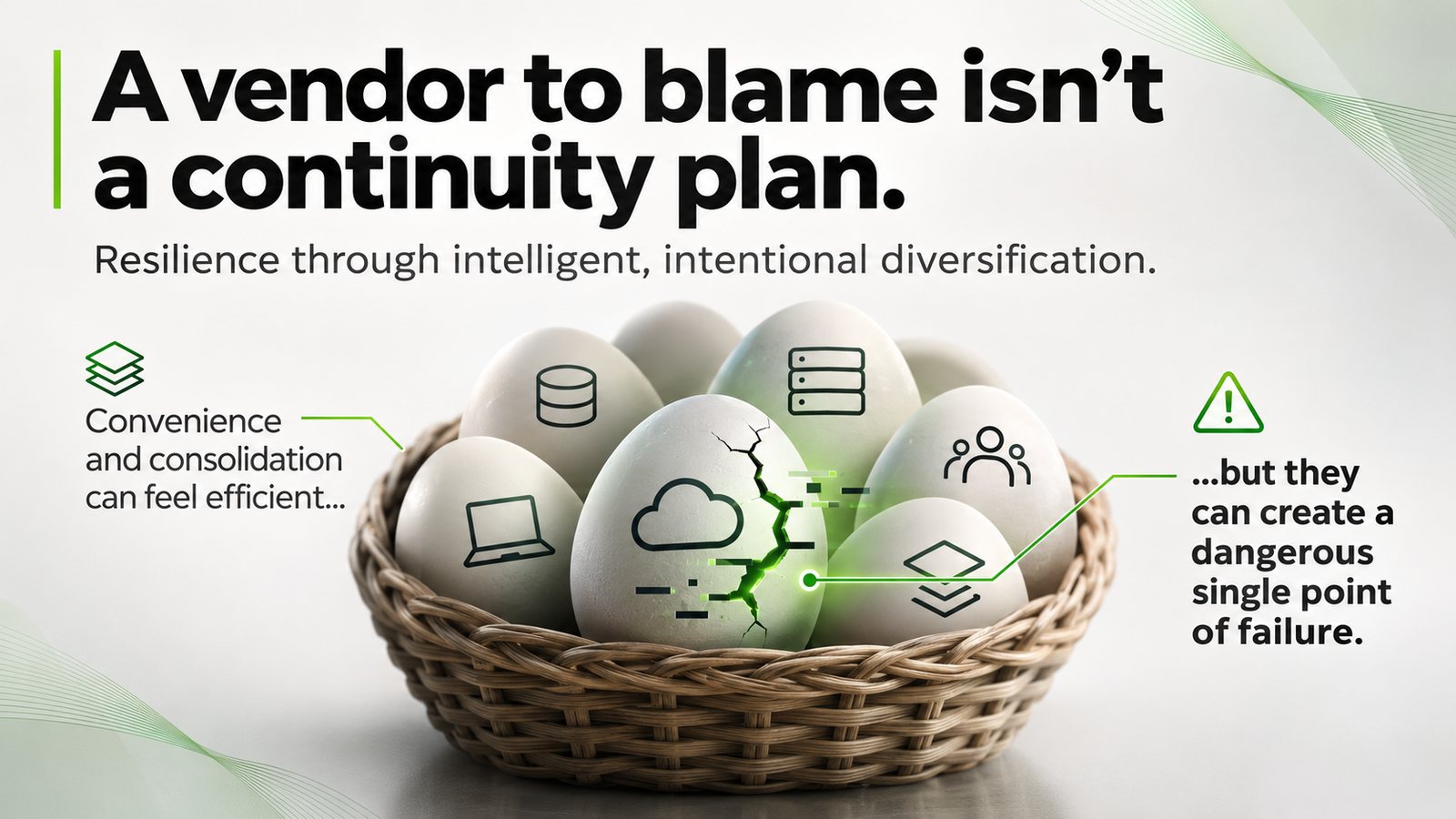
All your eggs in one basket. But hey, at least it’s an easy basket to manage.
That’s the deal a lot of organizations have quietly made with their technology. Pick a big, reputable vendor, move as much as you can into its ecosystem, standardize everything, and keep the moving parts to a minimum. Fewer contracts, fewer integrations, one support number to call. You end up with a platform that’s exceptional at nothing, but seemingly low-cost at everything.
I get the appeal. Frankly, if you’re the one managing IT every day, it’s hard to argue with. But I keep coming back to one question: are we optimizing technology for the people managing it, or for the business that depends on it?
We just got another reminder of what the answer should be. On the afternoon of Thursday, November 12, Microsoft 365 went down in a big way, starting with users across the Americas. Outlook, Teams, SharePoint, Copilot and a long list of other services went with it, Downdetector logged more than 100,000 reports within the first hour, and for a lot of organizations the disruption ran right into a second workday. By my count, that’s at least the third notable Microsoft 365 outage in about three months, following a late-August incident traced to a core authentication configuration that took email, Teams, SharePoint and OneDrive down together for days. When your email, files, meetings, automations and AI tools all sit behind the same front door, one bad change behind that door becomes everyone’s problem at the same time.
And when the technology stops, the business doesn’t get a pause button. Payroll still runs. Customers still call (assuming your VoIP phones aren’t part of the outage too). Invoices still need processing, and deadlines don’t move. A single technology failure turns into a business-wide failure pretty quickly.
The comfort of the conventional decision
There’s an unwritten rule in technology buying: nobody gets in trouble for picking the market leader. It may not be the best business decision, but it’s the easiest one to defend.
When everyone uses the same platform, it’s easy to explain why you chose it. And when that platform goes down, there’s a well-known vendor to point at. The service advisory gets forwarded around, a ticket gets opened, leadership hears that “Microsoft is having issues,” and everyone waits.
That waiting is the problem. It’s easy to defend a technology decision when everyone else made the same one. It’s a lot harder to defend the business impact when everyone goes down together.
Being able to explain why operations stopped isn’t the same as having built an organization that can keep going. A vendor to blame isn’t a business continuity plan.
When convenience becomes the strategy
Let me be clear: consolidation isn’t the villain here. Integrated ecosystems bring real benefits in security, administration, user experience and cost. In a lot of cases, consolidating is exactly the right call.
The trouble starts when consolidation becomes the default instead of one option weighed against what the business actually needs.
There’s an old saying: a jack of all trades is a master of none. Yet we keep asking one provider to be the best answer for email, collaboration, document management, workflow automation, reporting, security, AI and just about everything in between. Often not because anyone sat down and compared the options, but because it was already in the subscription, because adding another platform felt like more work, or because the decision was handed to someone whose job is keeping things stable, supportable and on budget.
Those are completely legitimate goals, and the IT admins and MSPs carrying them are doing their jobs. But stability and supportability aren’t a business strategy. Somebody also has to ask how technology can help the business grow, take friction out of how work gets done, and create a real edge. That usually means looking past the easiest answer.
A view from the document side
I spend most of my days in content management and process automation, so I tend to look at this through documents and workflows. A setup that’s become really common: email, file storage, forms, approvals and the automations tying them together all live in the same tenant and depend on the same sign-in. When that sign-in has a bad day, it isn’t just that nobody can send email. Nobody can find the contract, nobody can approve the invoice, and the workflow that was supposed to keep things moving is sitting there waiting too.
That’s not an argument for or against any particular product. It’s an argument for knowing where your critical content and processes actually live, and what they depend on, before the day you need them and can’t reach them.
Diversification isn’t about collecting vendors
The knee-jerk reaction to a big outage is “we should spread everything across more vendors.” That’s not really the answer either. More vendors can mean more cost, more complexity, more integrations to break and more security surface to manage. And plenty of different vendors still lean on the same cloud host, identity provider or network underneath.
What I’m advocating for is intelligent, intentional diversification: cutting the dependencies you don’t need, not piling up subscriptions. It also gives you more room to adapt as the tools in each area evolve. It’s hard to be digitally agile when everything is tied into one big pile. Four principles help.
1. Choose the best business fit. Measure solutions against your real requirements, workflows and goals. Something already included in your subscription might be the right choice, but “it was included” shouldn’t settle the decision on its own.
2. Know your shared points of failure. Map what your critical business functions depend on. What happens if your identity provider goes down? Your cloud platform? Your phones and messaging? Which processes stop cold, and which can keep limping along? You can’t design resilience around dependencies you’ve never written down.
3. Build continuity into everyday operations. A backup system doesn’t help much if nobody knows how to use it, the key information can’t be reached, or the process can’t run without the primary platform. Continuity takes technology, documented procedures, people who know the plan, and actually testing it, the same way you’d run a fire drill.
4. Make technology decisions at the business level. An IT admin will reasonably favor simplicity. An MSP will reasonably favor efficiency and predictable support costs. Leadership has to weigh those alongside revenue, growth, customer experience, competitive position and risk. None of those perspectives is wrong, but they aren’t interchangeable.
Managing technology vs. leading transformation
Keeping systems stable, secure and efficient is essential work. But transformation asks for more than keeping the lights on. It means looking hard at how work actually gets done, finding the friction (and frankly, the spots where staff have quietly given up), evaluating new capabilities, and sometimes bringing in tools that don’t fit neatly inside the existing vendor’s box.
It also means being willing to challenge the comfortable decision. The right strategy might consolidate some things, diversify others, redesign a few processes, and put contingency options in place that employees rarely touch but will be very glad to have the day something breaks.
The point isn’t more complexity. It’s a more capable organization. The goal isn’t more vendors. It’s fewer vulnerabilities.
A better question for leadership
Instead of asking “How much of our technology can we consolidate?”, try this:
“How well could our business run if our primary technology provider went down for a day? What about three?”
Then take it one step further:
“Are our technology decisions making the business more capable, or just making the IT environment easier to manage?”
Those questions belong in the leadership meeting, not just the IT meeting. Success isn’t measured by how many apps you eliminated or how many subscriptions you rolled up. It’s measured by how well technology helps the organization do what it’s there to do.
Efficiency matters. Integration matters. But resilience has to be intentional.
Where to start this week
- Get the right people in a room. Pull in leadership and a couple of front-line folks, and list the processes that would hurt most if your main platform went dark for a day.
- Map the dependencies. For each of those processes, note what it relies on: sign-in, storage, email, automation. Look for the spots where one failure takes out several things at once.
- Write down the “when it’s down” plan. Keep it simple, treat it like your laptop or acceptable-use policy, and make sure people can find it somewhere other than the system that’s down.
- Ask the honest question. Have your IT team or MSP walk you through what a multi-day outage would actually look like. If the answer is “we’d wait,” that’s your starting point.
At X-Tech Enterprises, we help organizations look past individual products and platforms and evaluate technology decisions in the context of business processes, operational risk and long-term goals. From technology assessments and solution strategy to process improvement and intentional automation, our focus is building technology environments that serve the business, not the other way around.